Scavenger Hunt – Nature
Skill: counting, observation, matching/sorting, shape
Resources: pencil(s), hunt list, clipboard or book (optional), clock
Activity: this cross-curricular fun activity celebrates BIODIVERSITY DAY. It is great way to get children excited about maths and nature. Children will have to look for certain materials found in nature, count them, record their results and communicate their mathematical thinking. By bringing maths into everyday experiences, like exploring in the garden, children can practice their mathematical skills in a meaningful way. This type of activity will deepen their understanding of mathematical concepts as well contribute positively to their wellbeing: spending time in nature has a very positive effect on our mental and physical health.
How to Play:
Create a list before you head out, choose as many items as you like. Check out our template below for ideas. Children may like to be involved in this process – brainstorm what natural materials and wildlife you expect/hope to find in the garden.
- Once you have devised a list, take note of the time on the clock, and then head outside.
- Begin by looking for the first object on your list. Count how many of those items you see. For example, there are 3 trees in the back garden
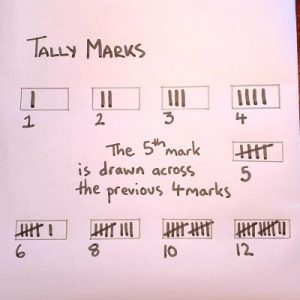
- Write down that number. Or if there are lots of those items it may be a good
idea to keep a tally instead (just put marks on a piece of paper but the 5th mark is drawn across the previous 4 marks (see below)
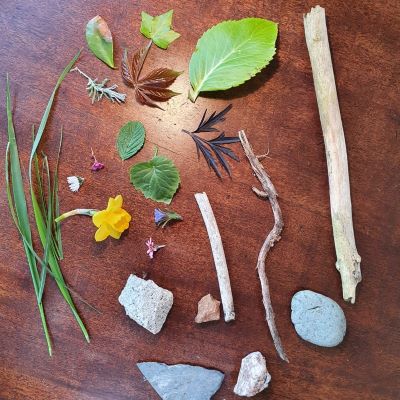
- You may wish to collect some of the natural items for further analysis later (between 10 and 20 items) e.g. sticks, round pebbles, fallen leaves, blades of grass, flower petals, shells)
- Continue through the list, searching for each of the items. Record how many of each kind you find. Take some sketches, tree rubbings or photographs.
- Don’t forget to take your time and look around – you may see some other interesting items that weren’t on your list. What other maths can you see around you?
- When you’re done, look at the results. Which natural item did you find the most of? The least? Which stick is the longest/shortest/thickest/thinnest etc.
- Record the time on the clock again. How long did you spend scavenging?
Search for as many of the following items as possible
Extension to the activity
Once you have completed the scavenger hunt, it’s now time to look at all the materials in more detail. Children should be prompted to sort, match, compare, count, discuss and analyse their findings.
- How many sticks did you get?
- Arrange them in any order you would like. Which is longest/shortest? Thickest/thinnest?
- How many pebbles/rocks did you gather?
- Which one is the heaviest/lightest?
- Sort the leaves in terms of colour/size/texture
- What are the similarities between these leaves?
- What are the differences?
- How many petals do each of your flowers have? Children may analyse and report that they didn’t find any flowers with 9 petals, for example
- Which flower had the most petals?
- Which flower had the biggest petals?
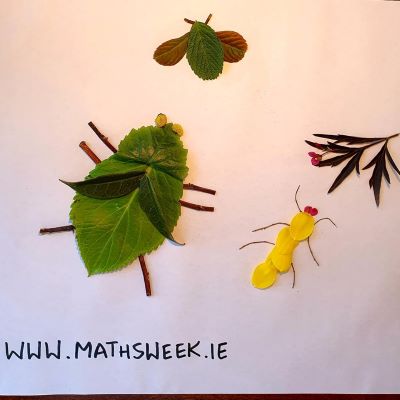
Make some art with all the material.
You could roll a dice to decide how many pieces of each material you can use or create some nature scenes using any materials you like.