
It’s About Time
This page is all about time. Our ancient ancestors needed to measure the passage of time. The need to measure and predict the seasons led to the development of the calendar. The passage of the Sun across the sky signaled the passing of the day. This measurement is part of mathematics and the need for more precise measurement and prediction led to the development of sophisticated mathematics of thousands of years. Here we have some information and activities for you to spend your time with.
Why do the Clocks change in Spring and Autumn?
Posted on 28/03/20
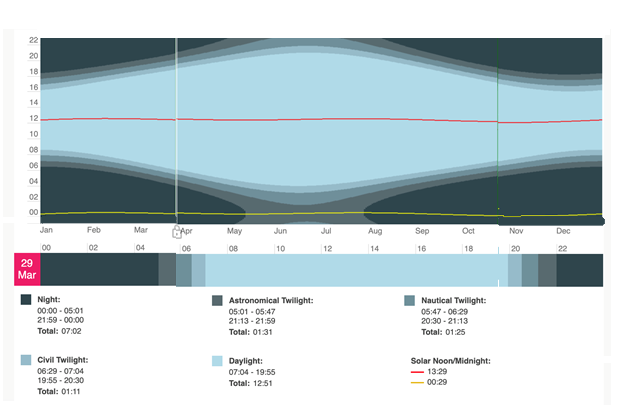
Why do the clocks change?
It’s the time of the year again: spring forward! Clocks around the world change and spring one hour forward from 1 am to 2 am* on Sunday morning 28 March.
All over the world? No.
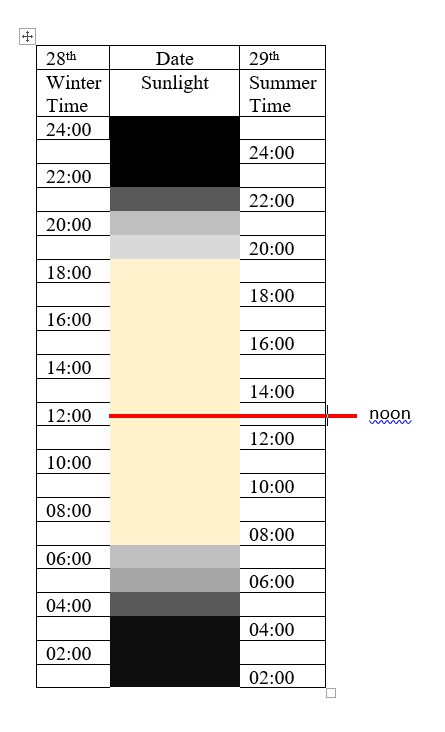
Summer time – or daylight saving time – was introduced to save energy and make the most of daylight. Moving the clock forward allows us on the island of Ireland and everyone in Europe to enjoy one more hour of sunlight in the evening at the expense of an hour sunlight in the morning in the months between spring and autumn equinox.
This only works because of our position on the Earth. We are on the northern hemisphere where the days are longer in summer and shorter in winter.
On equinox, the daytime period is as long as the night time period. Because the Earth is tilted by 23.5° and because it rotates around itself once each day while also rotating around the sun each year, the number of daylight hours we get varies depending on where we are on the Earth and what time of the year it is.
The Earth rotates around it’s own axis and one rotation is completed in one day. This means the Earth rotates 360 ° per day or 15 ° per hour. Ideally, this would mean that our position in relation to the sun only changes by 15 ° each hour. The Earth, however, also rotates around the sun and it is tilted by 23.5 ° which means that half the year the northern hemisphere is tilted towards the sun and the other half of the year the southern hemisphere is turned towards the sun. This causes the changes in daytime hours. This also causes the changes in season: while we are now in the middle of spring, the trees are changing colour in autumn in New Zealand. But what happens when we come to equator? The closer we come, the less variation is there in length of the days throughout the year and at the equator, the daytime period lasts about 12h each day.
It doesn’t make much sense for countries at or close to the equator to change the clock. In general, daylight saving time is not observed in countries around the equator or inside the the tropics. Many countries – but not all – further from the equator change their clocks but while the clocks in the Northern hemisphere spring forward in March, the clocks in most countries in the Southern hemisphere spring forward in September or early October.
In 2018, the European Parliament had a vote regarding the abolition of daylight saving time which received much support from citizens in an online survey. The final decision has not been made but this might well be the last time the clocks spring forward in March!
- Readers from Central European Time Zone will know that they change their clocks at 2 am to 3 am. This is so that all countries changing change at the same instant. (1 am in Ireland and UK is 2 am in Europe)
Effect of changing the clocks forward one hour between 28 and 29 March
You can learn more about this at Time and Date Website