
Irish Times Maths Week Poster 2022
We will be present the poster and the answers to the puzzles here on Thursday 20 October.
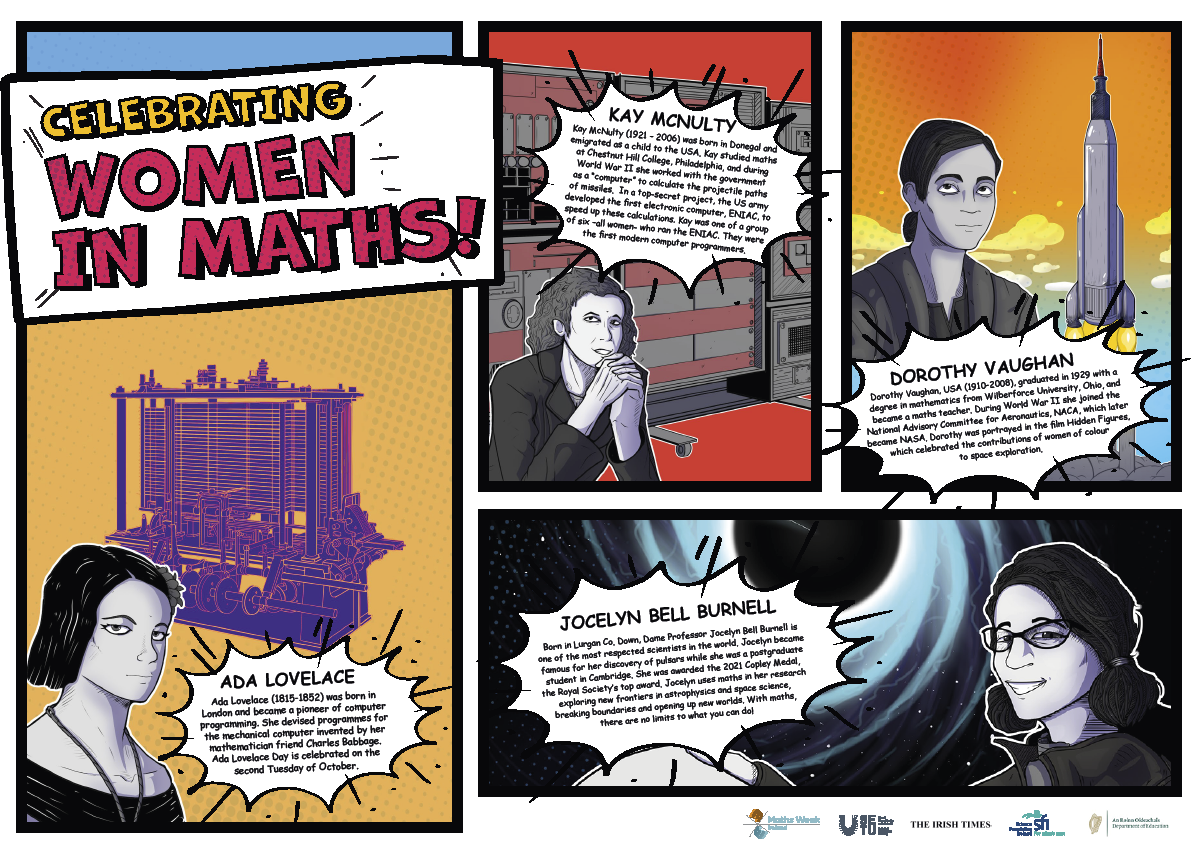
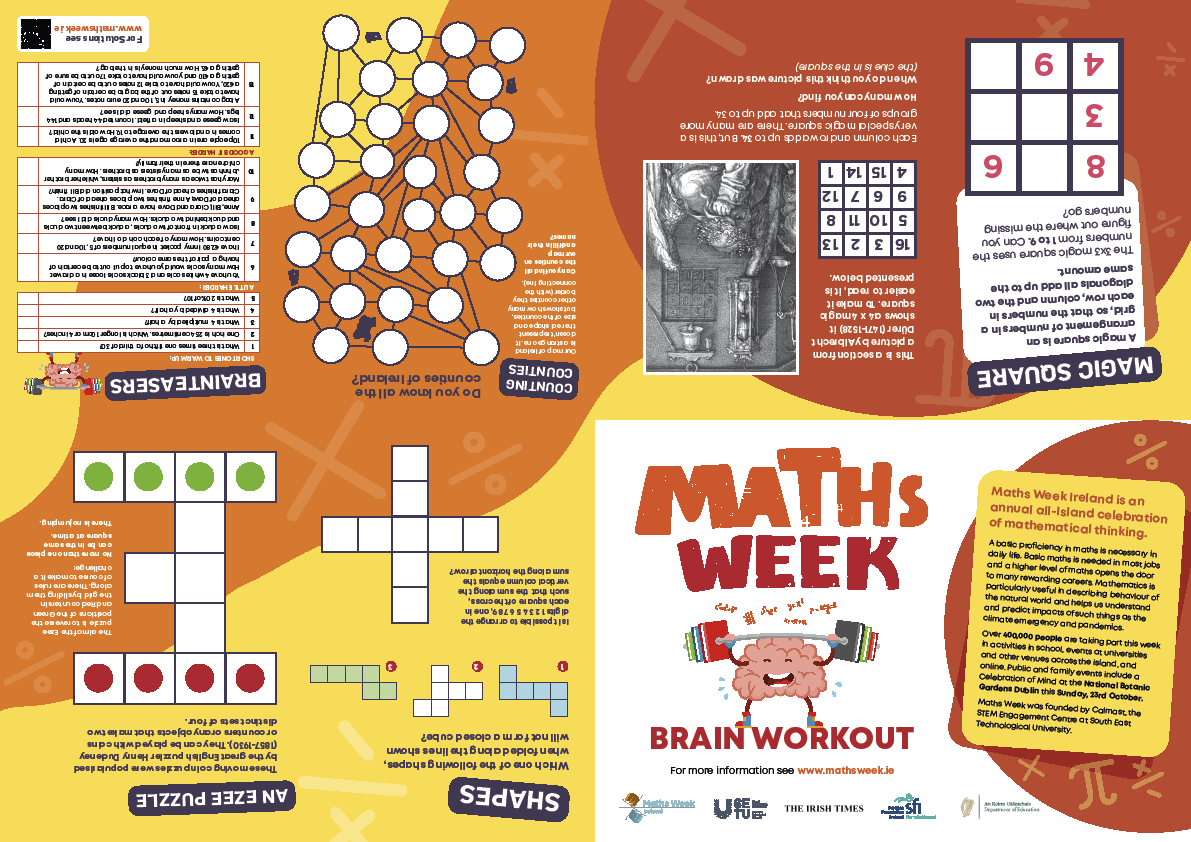
One side will contain puzzles and games to give your brain a good workout and the reverse will feature an attractive poster celebrating women in mathematics.
We will be present the poster and the answers to the puzzles here on Thursday 20 October.
Maths Week Ireland is an annual all-Island celebration of mathematical thinking. A basic proficiency in maths is necessary in daily life. Basic maths is needed in most jobs and a higher level of maths opens the door to many rewarding careers. Mathematics is particularly useful in describing behaviour of the natural world and helps us understand and predict impacts of such things as the climate emergency and pandemics.
Over 400,000 people are expected to take part in activities in school, events at universities and other venues across the island, and online. Public and family events include a Celebration of Mind at the National Botanic Gardens Dublin next Sunday, 23rd October.
Maths Week was founded by Calmast, the STEM Engagement Centre at South East Technological University.
For more information see www.mathsweek.ie
Puzzle Solutions 2022 Poster
With the poster was published in the Irish Times on Thursday 20 October, please find our answers below
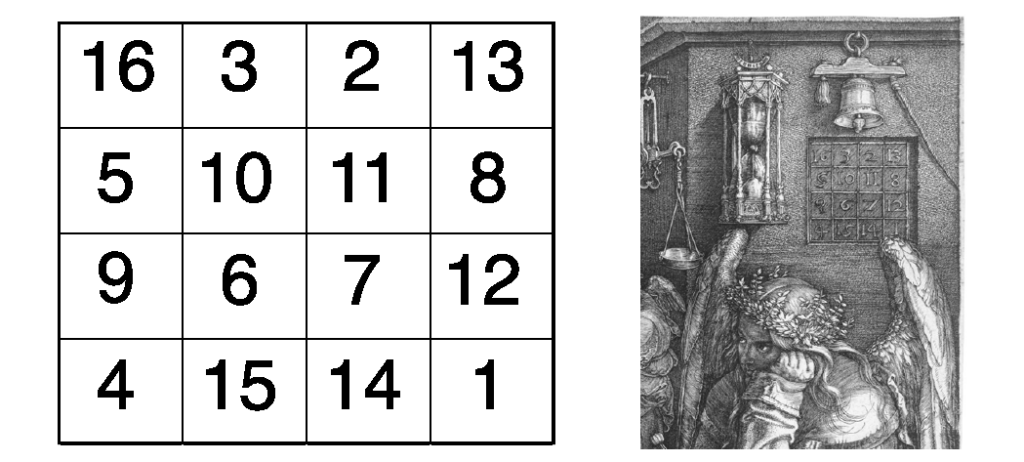
Picture by Albrecht Dürer (1471-1528)
This is a section from a picture by Albrecht Dürer (1471-1528) it shows a 4 x 4 magic square. To make it easier to read, it is presented below.
Each column and row adds up to 34. But, this is a very special magic square. There are many more groups of four numbers that add up to 34.
How many can you find?
When do you think this picture was drawn? (the clue is in the square)
Answers
People have reported 86 different sets of four numbers that add up to the magic constant of 34. The more obvious ones are– four rows, four columns, two diagonals, the four quadrants, the four numbers in the middle and the four numbers at each corner.
The picture was made in year 1514 (clue: centre of bottom row)
Square of the Cross
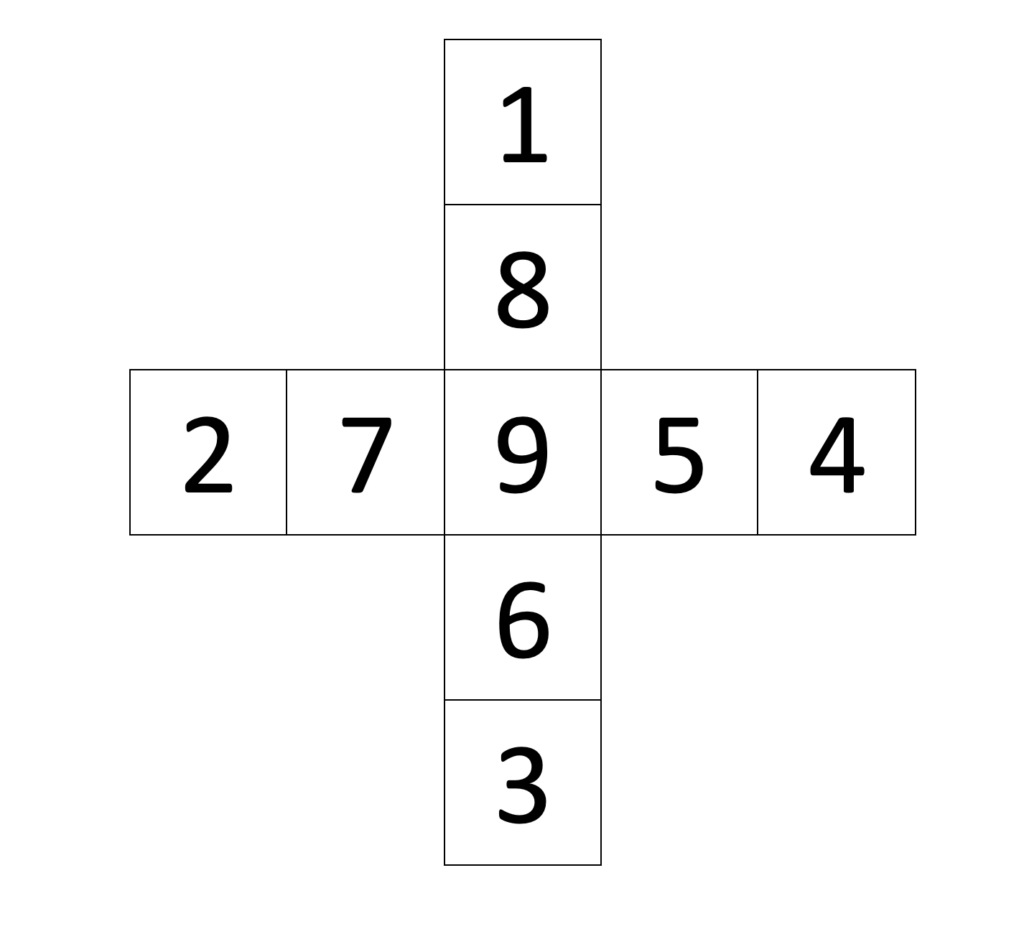
Is it possible to arrange the digits 1 2 3 4 5 6 7 8 9, one in each square of the cross, such that the sum along the vertical column equals the sum along the horizontal row?
This can be solved with any odd number in the centre square.
When we put a number in the centre square the remainder must be divided into two equal parts.
1+2+3+4+5+6+7+8+9 = 45
IF we have an odd number in the centre square we will have an even sum left. If we put 9 in the centre square the remaining numbers add up to 36. So there should be 18 in each arm along with the centre 9
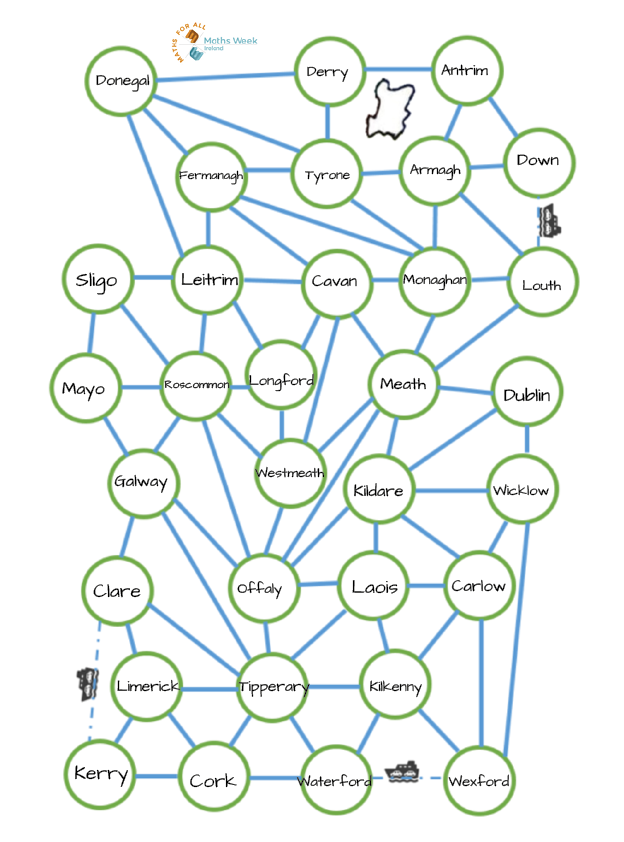
Counting Counties
An Ezee Puzzle
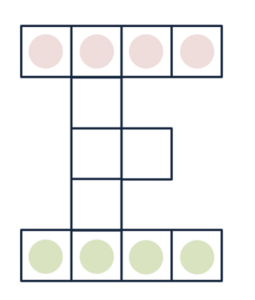
These moving coin puzzles were popularised by the great English puzzler Henry Dudeney (1857-1930). They can be played with coins or counters or any objects that make two distinct sets of four.
The aim of the E puzzle is to reverse the positions of the Green and Red counters in the grid by sliding them along. There are rules of course to make it a challenge:
- No more than one piece can be in the same square at a time.
- There is no jumping.
Magic Squares
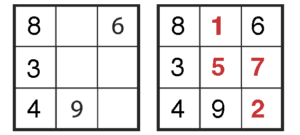
The left-hand column adds up to 15, which tells us that all columns, rows and diagonals must add up to 15.
So we see for top row 8 + 6 = 14 so the missing number must be 1. The middle column then is 1+ 9 = 10 so the centre number should be 5.
Form a Closed Cube
Which one of the following shapes, when folded along the lines shown will not form a closed cube?
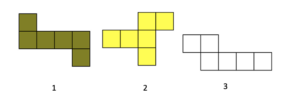
Number 3 cannot fold into a box
Brainteasers
Errata: There were two errors in the short brain teasers. These were the fault of Maths Week not the Irish Times. Rough work got mixed up with the submitted text.) Thanks to a reader for pointing this out to us and apologies for any frustration caused.
Question 10. The answer should be 4: two boys and two girls. This Mary has two brothers (twice as many) and one sister and John has two sisters (twice as many) and one brother.
Question 13. Unluckily for us, the figures given in the question were wrong. This is a greater error as it may have caused frustration.
The values should have been given as:
A bag contains money in 5, 10 and 20 euro notes. You would have to take
- 16 notes out to be sure of getting a €20.
- 15 notes to be sure of getting a €10
- 14 notes out to be sure of getting a €5
How much money is in the bag?
We present the method below

Summarizing our data from Question 13:
- 16 notes out to be sure of getting a €20. That means there is 15 €5 and €10 notes
- 15 notes to be sure of getting a €10. That means there is 14 €5 and €20 notes
- 14 notes out to be sure of getting a €5 That means there is 13 €10 and €20 notes
We can proceed by trial and error: picking some starting values and testing them out.
Here though, we will use the method of simultaneous equations to solve the problem. We need to express our information in mathematical form:
For convenience we will call the number of €20’s T, the number of €10’s X and the number of €5’s V.
Then we can write our three pieces of information from above as follows
- V + X = 15
- V + T = 14
- X + T = 13
Subtract 2. from 1.
V + X = 15
-(V + T = 14)
Gives us
X – T = 1
Adding this combined information from 1. and 2. to 3.
X – T = 1
+ X + T = 13
Gives us 2X = 14
Therefore X, the number of €10 notes is 7.
If X is 7 and X + T = 13, then T must be 6.
V = X = 15 so V must be 8.
Number of €5 (V) = 8 = €40
Number of €10 (X) = 7 =€70
Number of €20 (T) = 6 = €120
Total amount of money in the bag is €40 + €70 + €120 = €230
Climate Action with Maths
Save Energy, Save Money
Electrical appliances that generate heat or movement generally use the most electricity.
Only fill your kettle for what you will need. Don’t boil a full kettle for one cup of tea!
Make sure your dishwater and washing machine are full before running.
Dry clothes on a clothes horse if you can.
Switch appliances off when you don’t need them.
Investigate how technology can help you.
Check out Sustainable Energy Authority of Ireland
and NIdirect
for more advice.

This poster was distributed with the Irish Times on Tuesday 19 October 2021
Answers
BEDROOM [24 cm]
BATHROOM [45 l]
KITCHEN [360 kg]
LIVING ROOM [5.84 kWh]
BICYCLE [8:50]
CAR [1904 kg]