
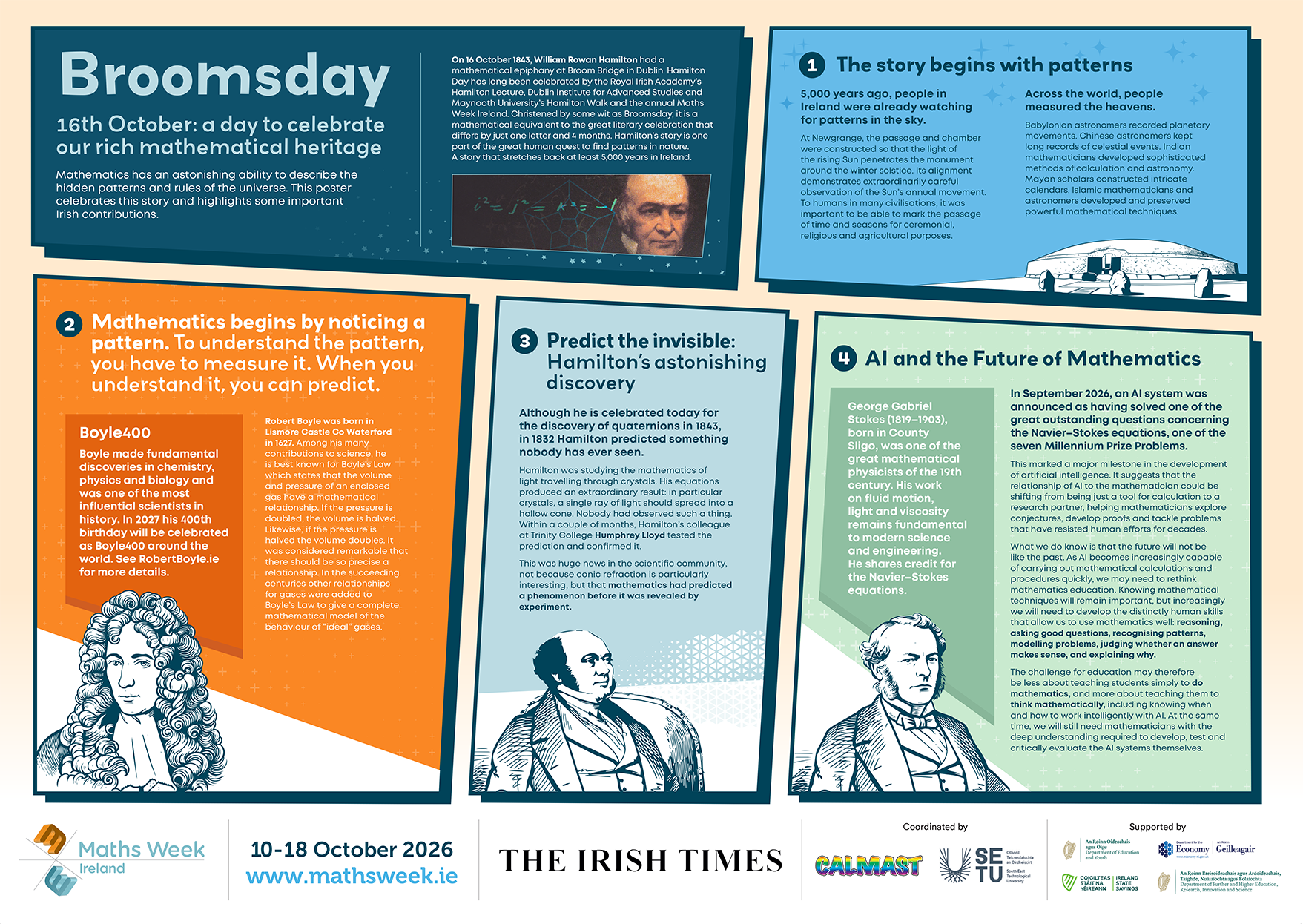
This year’s Irish Times Poster celebrates Broomsday and our rich mathematical heritage
You can see answers to the puzzles below.
See Solutions to the puzzles below
Broomsday: Celebrating our rich mathematical heritage
Mathematics has an astonishing ability to describe the hidden patterns and rules of the universe. This poster celebrates this story and highlights some important Irish contributions.
On 16 October 1843, William Rowan Hamilton had a mathematical epiphany at Broombridge in Dublin. Hamilton Day has long been celebrated by the Royal Irish Academy’s Hamilton Lecture, Dublin Institute for Advanced Studies and Maynooth University’s Hamilton Walk and the annual Maths Week Ireland. Christened by some wag as Broomsday, it is a mathematical equivalent to the great literary celebration that differs by just one letter and 4 months. Hamilton’s story is one part of the great human quest to find patterns in nature. A story that stretches back at least 5,000 years in Ireland.
- LOOK UP: The story begins with patterns
5,000 years ago, people in Ireland were already watching for patterns in the sky.
At Newgrange, the passage and chamber were constructed so that the light of the rising Sun penetrates the monument around the winter solstice. Its alignment demonstrates extraordinarily careful observation of the Sun’s annual movement. To humans in many civilisations it was important to be able to mark the passage of time and seasons for ceremonial, religious and agricultural purposes.
Across the world, people measured the heavens.
Babylonian astronomers recorded planetary movements. Chinese astronomers kept long records of celestial events. Indian mathematicians developed sophisticated methods of calculation and astronomy. Mayan scholars constructed intricate calendars. Islamic mathematicians and astronomers developed and preserved powerful mathematical techniques.
Mathematics begins by noticing a pattern. To understand the pattern, you have to measure it. When you understand it, you can predict.
The extraordinary idea: Earth and the heavens obey the same rules.
The observation of heavenly bodies was an important part of the emergence of science.
In 1543, On the Heavenly Bodies was published in which Copernicus argued that the Sun was the centre of the solar system, rather than the Earth as was held for 1,400 years. In the 1600’s there was a remarkable progress in our understanding of the world.
Kepler (1571-1630) determined that the orbits of planets follow mathematical rules.
Galileo (1564-1642) discovered that falling and moving objects can be measured and described mathematically.
Boyle (1627-1691) showed that a precise mathematical relationship can be observed between the pressure and volume of a gas. This was further evidence that the natural world on the earth as well as in the heavens was governed by mathematical relationships.
Newton (1642-1727) realised that same force that causes an apple to fall also caused the motion of the Moon. He developed a mathematical law that described bodies moving in space and also bodies falling on earth.
2. Robert Boyle was born in Lismore Castle Co Waterford in 1627. Among his many contributions to science, he is best known for Boyle’s Law which states that the volume and pressure of an enclosed gas have an inverse relationship. If the pressure is doubled, the volume is halved. Likewise, if the pressure is halved the volume doubles. It was considered remarkable that there should be so precise a relationship. In the succeeding centuries other relationships for gases were added to Boyle’s Law to give a complete mathematical model of the behaviour of “ideal” gases. Boyle made fundamental discoveries in chemistry, physics and biology and was one of the most influential scientists in history. In 2027 his 400th birthday will be celebrated as Boyle400 around the world. See RobertBoyle.ie for more details.
- DO THE MATHS: Numbers can reveal what our eyes cannot
Mathematics was not content to just account for observation. The real power of mathematics in science is to predict.
A heart, some arithmetic and a revolutionary idea
The old model held that blood was continuously produced and consumed by the body. William Harvey proposed the circulation of the blood, not from observation, but from mathematics. He estimated how much blood the heart expelled on each beat and multiplied it by the number of beats. The result was far more blood than food could possibly continually replace. His conclusion: the blood must be circulating. Over 30 years would pass before capillaries were observed.
- PREDICT THE INVISIBLE: Hamilton’s astonishing discovery
In 1832: Hamilton predicts something nobody has ever seen
Hamilton was studying the mathematics of light travelling through crystals. His equations produced an extraordinary result: in particular crystals, a single ray of light should spread into a hollow cone. Nobody had observed such a thing. Within a couple of months, Hamilton’s colleague at Trinity College Humphrey Lloyd tested the prediction and confirmed it.
This was huge news in the scientific community, not because conic refraction is particularly interesting, but that mathematics had predicted a phenomenon before the experiment revealed it.
William Rowan Hamilton
William Rowan Hamilton was born in Dublin in 1805 and died in Dublin in 1865. Hamilton was a child prodigy, reportedly speaking a dozen languages as a child. He was appointed Andrews Professor of Astronomy shortly before he graduated from Trinity College Dublin. This also made him the Royal Astronomer for Ireland, and he lived and worked at Dunsink Observatory, near Finglas to the west of Dublin. Among Hamilton’s many great achievements he was most proud of quaternions. These are sets of four numbers that can be used to describe the position and orientation of bodies in space. He was walking along the Royal Canal and while approaching Broombridge near Cabra, he had a flash of inspiration and saw a solution of a problem he had been working on for years. He carved the equations of quaternions on Broombridge on October 16th 1843.
The unreasonable usefulness of mathematics.
Many mathematicians pursue mathematics for its own worth and beauty unconcerned with practical applications. But, even the most abstract and esoteric maths may find unexpected uses in succeeding generations. Quaternions had little or no practical use at the time, but it was a daring move in mathematics as he had created a new algebra with its own rules. While quaternions only had a brief vogue, Hamilton’s originality and daring inspired other mathematicians to create fruitful new mathematical worlds. Quaternions found real life applications over a century later. They are useful for moving objects in computer animation and for manoeuvring spacecraft.
Another good example is the work of George Boole, first professor of mathematics at UCC. He created Boolean Algebra in an attempt to create a mathematical representation of logic. In the 20th Century Boole’s algebra became the basis for all digital electronics, telecommunications and internet. Our modern world would not be possible without it.
- BUILD A MODEL: A universe you can experiment with
What if you could experiment on the future?
Some things are too big or costly to experiment on. But we can build a mathematical model: a simplified mathematical description of something in the real world.
- Weather & climate
- Epidemics
- Medicine
- Aircraft
- Bridges
- Floods & oceans
- Communications
- Galaxies and black holes
A climate model combines mathematical descriptions of the atmosphere, oceans, land, ice and energy from the Sun. The accuracy of the model is estimated by test models against observations and past climate.
Models don’t tell us the future with magical certainty, they allow us to ask: “If these conditions change, what outcomes are likely?”
- AI THE FUTURE OF MATHEMATICS
Fluid flow is extraordinarily complicated. The Navier–Stokes equations are used to model how fluids such as air and water move, with applications ranging from the aerodynamics of cars and aircraft to blood flow, weather and climate modelling.
Engineers and scientists have used these equations successfully for many years, but mathematicians have also been investigating deep questions about the equations themselves.
In September 2026, an AI system was announced to have solved one of the great outstanding questions concerning the Navier–Stokes equations, one of the seven Millennium Prize Problems.
This marked a major milestone in the development of artificial intelligence. It suggests that the relationship of AI to the mathematician could be shifting from being just a tool for calculation to a research partner, helping mathematicians explore conjectures, develop proofs and tackle problems that have resisted human efforts for decades.
What we do know is that the future will not be like the past. As AI becomes increasingly capable of carrying out mathematical calculations and procedures quickly, we may need to rethink mathematics education. Knowing mathematical techniques will remain important, but increasingly we will need to develop the distinctly human skills that allow us to use mathematics well: reasoning, asking good questions, recognising patterns, modelling problems, judging whether an answer makes sense, and explaining why.
The challenge for education may therefore be less about teaching students simply to do mathematics, and more about teaching them to think mathematically, including knowing when and how to work intelligently with AI. At the same time, we will still need mathematicians with the deep understanding required to develop, test and critically evaluate the AI systems themselves.
[panel pic of stokes]
George Gabriel Stokes (1819–1903), born in County Sligo, was one of the great mathematical physicists of the 19th century. His work on fluid motion, light and viscosity remains fundamental to modern science and engineering. He shares credit for the Navier–Stokes equations.
Who is missing from this story?
This poster focusses on some of the Irish contribution to mathematics, but mathematics belongs to all humanity and many cultures have contributed to its development. Although there are many striking exceptions, women over most of history were not encouraged or allowed to participate. In modern times women are well represented at the top of mathematics and there are many important Irish pioneers of mathematics are celebrated on the MathsIreland.ie website. These include:
Alice Boole (later Stott, 1860-1940) was born into the Boole family in Cork and despite having no university education, made important contributions on four-dimensional geometry and was a pioneer in the visualisation of 4-dimanesional solids.
Sheila Power (later Tinney, 1918-2010) was a UCD graduate. She completed her PhD in 1941 in quantum mechanics under Nobel prize-winning Max Born at Edinburgh in just two years at the age of 23. On returning to Ireland, she has a long career as an academic in UCD and also became one of the first three resident scholars at the then new Dublin Institute of Advanced Studies.
Kay McNulty (later Antonelli, 1921–2006), from County Donegal, earned a degree in mathematics in Philadelphia. During the Second World War, she was recruited by the U.S. Army to calculate ballistic trajectories. She later became one of six young women selected to program ENIAC, one of the first general-purpose electronic computers.
There were no programming languages or manuals: the women had to work out how to program the machine themselves, using switches, cables and the electrical diagrams. Their pioneering contribution went largely unrecognised for decades. Kay McNulty was one of those six women.
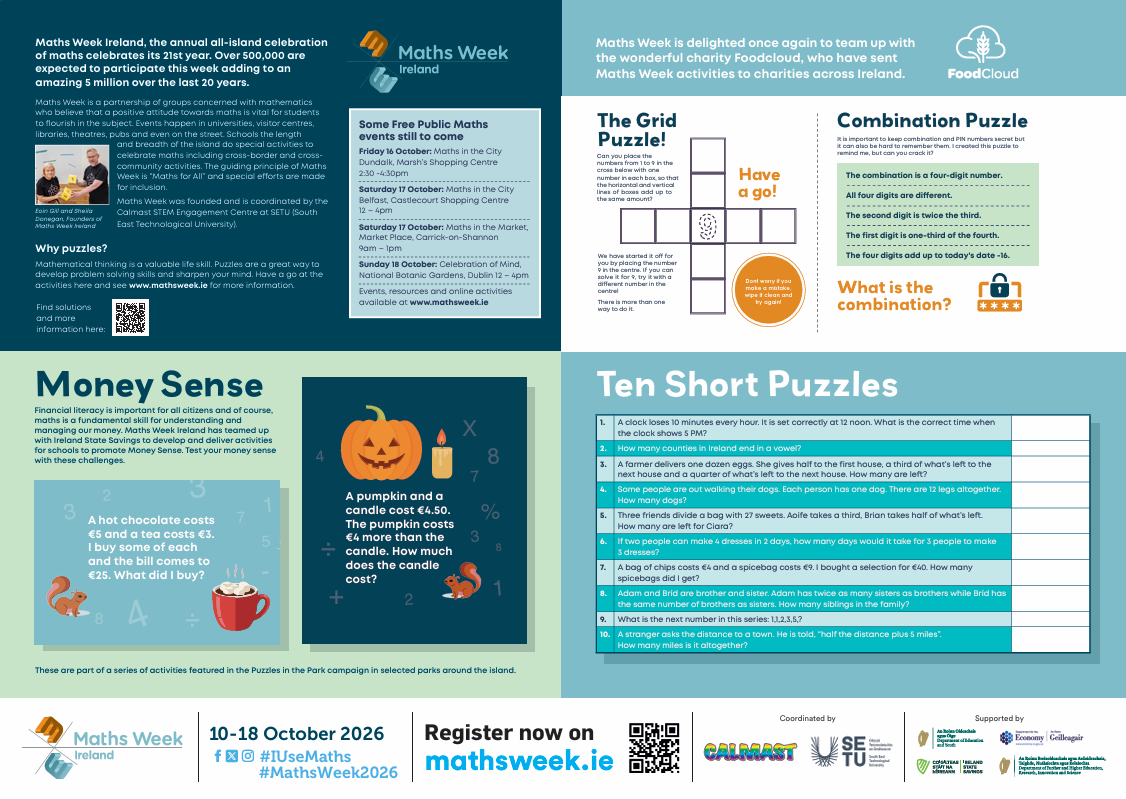
Puzzles and Activities Page
Solutions
Combination Puzzle: 1843
Grid Puzzle:
One solution is
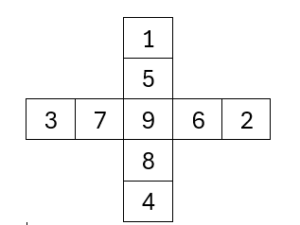
It is impossible with an even number on the middle. All the numbers in the grid add to 45. If there is an even number in the middle then the other 8 numbers would add up to an odd number and that cant be divided in two equal sums. Say, 2 is in the middle then the other 8 numbers will add up to 43 and that cant be divided equally between horizontal and vertical.
Money Sense
A hot chocolate costs €5
A Tea costs €3
Two hot chocolates (2x€5 = €10) and 5 Teas (5x€3=€15)
Candle costs 25c
The pumpkin and a candle costs €4.50. The pumpkin costs €4 more than the candle.
A pumpkin costs €4.25 and a candle costs 25c
Ten short puzzles
- 6pm
- 5: Clare, Kildare, Mayo, Sligo, Tyrone
- 3 eggs left. (gives 6 to first house, 2 to the second and 1 to the third)
- 2 dogs
- 9 sweets
- 1 day: two people make 4 dresses in 2 days. 1 person makes 1 dress in 1 day. £ people make 3 dresses in 1 day.
- 4 Spicebags
- 7 Children
- 8 (Fibonacci sequence – each number is the sum of the previous 2)
- 10 miles.